
Top 5 Indicators of Hard Water Problems in Cooling Towers
Introduction
Industrial cooling towers are the unsung heroes of manufacturing plants, data centers, and large commercial facilities. They work tirelessly to reject heat and keep your operations running smoothly. But there is a silent threat lurking inside your water supply that can quietly cripple your system: hard water.
When dissolved minerals like calcium and magnesium accumulate in your system, they don’t just disappear. They settle on critical components, dragging down your cooling tower efficiency and skyrocketing your operating costs.
Recognizing the early warning signs of hard water issues can save your facility thousands of dollars in emergency repairs and unplanned downtime. In this comprehensive guide, we will break down the top 5 indicators of a hard water problem in cooling towers and share actionable strategies to protect your equipment.
What Causes Hard Water Problems in Cooling Towers?
Before diving into the symptoms, it is important to understand why cooling towers are uniquely vulnerable to hard water.
Cooling towers reject heat through evaporation. As pure water evaporates into the atmosphere, it leaves behind all its dissolved minerals. This process continually concentrates the calcium, magnesium, and silica left in the remaining basin water a cycle known as cycles of concentration (CoC).
If these mineral levels are not actively managed through proper cooling tower water treatment, the water becomes supersaturated. The minerals then precipitate out of the liquid, bonding to the internal surfaces of your tower.
The Top 5 Indicators of Hard Water Problems in Cooling Towers
How do you know if hard water is staging a takeover in your facility? Keep a close eye out for these five undeniable warning signs.
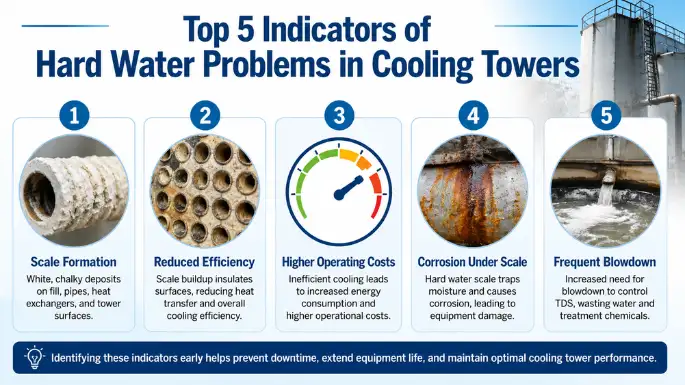
1. Visible Scaling on Fill Media and Internal Surfaces
The most obvious indicator of hard water is the physical presence of scale. Scale is a hard, chalky, white or off-white mineral deposit consisting primarily of calcium carbonate (CaCO3).
You will typically notice scale forming first on the cooling tower fill media and distribution nozzles. The fill media is designed to maximize surface area for water-to-air contact. When scale covers this media, it blocks airflow and prevents efficient evaporation, severely crippling the tower’s ability to cool.
2. Gradual Reduction in Cooling Performance
Have you noticed that your process equipment is running hotter, or your HVAC system is working harder to maintain baseline temperatures? A drop in cooling tower efficiency is a classic symptom of hard water.
Scale acts as an incredibly effective thermal insulator. In fact, calcium carbonate scale is an excellent barrier to heat transfer meaning it keeps heat in the system rather than letting it escape. Even a microscopic layer of scale on your heat exchanger tubes can drastically cut heat transfer efficiency, forcing your entire system to consume more energy to achieve the same cooling output.
3. Accelerated Galvanic and Under-Deposit Corrosion
It seems counterintuitive, but hard water scale directly triggers localized corrosion. When mineral deposits settle unevenly on metal surfaces, they trap moisture, oxygen, and bacteria underneath them.
This creates a localized environment known as under-deposit corrosion. Because the metal beneath the scale is deprived of oxygen compared to the surrounding bare metal, an electrochemical cell forms. This leads to rapid pitting, pinhole leaks, and premature structural failure of your cooling tower basin or piping.
4. Frequent Clogging of Distribution Nozzles
For a cooling tower to work perfectly, water must be distributed evenly across the fill media. This is achieved via a network of spray nozzles.
Hard water causes mineral buildup to constrict these nozzle openings. When nozzles clog, you get dry spots on your fill media and uneven air-to-water contact. The water that does get through flows in heavy, localized streams, completely derailing the evaporation process and adding unnecessary stress to your pumps.
5. Spiking Energy Bills and Maintenance Costs
If your monthly utility bills are creeping upward without an increase in production volume, hard water might be the culprit.
Because scale forces your chiller compressors and cooling tower fans to run longer and harder to reject the same amount of heat, your energy consumption spikes. Additionally, if your maintenance team finds themselves constantly acid-washing heat exchangers, punching tubes, or replacing scaled-out fill media, your high maintenance costs are a direct reflection of a water quality issue.
The Consequences of Ignoring Hard Water Issues
Leaving hard water unmanaged leads to a domino effect of operational headaches. The table below outlines exactly how unmanaged water quality directly impacts your bottom line:
Hard Water Symptom | Operational Impact | Financial Consequence |
0.03-inch scale layer | 10% to 11% drop in heat transfer | Higher monthly electrical bills |
Clogged spray nozzles | Uneven water distribution | Reduced cooling capacity, hot processes |
Under-deposit pitting | Pinhole leaks in piping/basin | Costly emergency structural repairs |
Uncontrolled bio-films | Increased risk of Legionella | Regulatory fines and health hazards |
Actionable Solutions: How to Combat Hard Water
You do not have to let hard water dictate your facility’s efficiency. By implementing a proactive cooling tower water treatment regimen, you can reverse mineral buildup and keep your systems operating at peak performance.
Implement a Custom Chemical Treatment Program
Work with a water treatment specialist to introduce specific scale inhibitors into your system. Phosphonates, polymers, and specialty dispersants hold calcium and magnesium ions in suspension, preventing them from bonding to metal and plastic surfaces even at high concentration cycles.
Utilize Automated Blowdown Control
Blowdown (or bleed-off) is the process of draining a portion of the mineral-rich water from the cooling tower basin and replacing it with fresh makeup water. Installing an automated conductivity controller ensures that blowdown happens precisely when mineral thresholds are crossed, minimizing water waste while preventing scale formation.
Install a Water Softening Pre-treatment System
If your source water (makeup water) is exceptionally hard, treating it before it enters the cooling tower is a highly effective strategy. Water softeners use ion exchange to swap out scale-forming calcium and magnesium ions for non-scaling sodium ions, neutralizing the threat at the source.
Establish a Routine Preventive Maintenance Schedule
Regular physical inspections are your best line of defense. Ensure your team checks the distribution deck, cleans fouled nozzles, and monitors approach temperatures weekly. Bi-annual professional cleanings will clear away light mineral dust before it bakes into rock-hard scale.
The Benefits of Regular Water Treatment and Preventive Maintenance
Investing in consistent water quality management yields massive dividends for industrial operations:
- Extended Equipment Lifespan: Eliminating scale and under-deposit corrosion means your cooling towers and chillers will last decades, maximizing your return on investment (ROI).
- Optimized Energy Efficiency: Keeping heat exchanger surfaces clean ensures minimal energy consumption, shrinking your facility’s carbon footprint and utility expenses.
- Minimized Downtime: Scheduled, proactive maintenance takes just hours; dealing with a catastrophic scale-induced system shutdown can stop your production lines for days.
Conclusion:
Hard water is an inevitability for most industrial facilities, but a hard water problem in cooling towers is completely preventable. By keeping a watchful eye out for visible scale, declining thermal performance, clogged nozzles, and rising utility bills, you can catch mineral buildup before it triggers a catastrophic system failure.
Partnering with a professional water treatment team ensures your systems stay clean, your energy bills stay low, and your facility keeps running at maximum velocity.
Restore Your Cooling Tower Efficiency Today!
Don’t let hidden mineral scales drain your profitability. Our team of industrial water specialists is ready to design a tailored cooling tower water treatment plan optimized for your facility’s unique water chemistry.
Frequently Asked Questions (FAQs)
Does a water softener remove bacteria from hospital water?
No. A water softener only removes minerals like calcium and magnesium. To kill bacteria and pathogens, the hospital must use UV sterilization, chlorination, or ultrafiltration.
Is softened water alone enough for dialysis machines?
No. Softened water is only a “pre-treatment” step. Dialysis requires much higher purity, which is achieved by passing the softened water through Reverse Osmosis (RO) and deionization systems.
How does hard water cause "white spots" on surgical tools?
During sterilization, hard water minerals carry over into the steam. When the steam evaporates, it leaves behind calcium deposits (white spots) that can harbor bacteria and damage delicate instruments.
Can a water softener reduce a hospital's energy bills?
Yes. Even 1.5mm of scale buildup can increase energy consumption by 15% to 25%. By keeping heating elements clean, a commercial water softener ensures the system runs at peak efficiency.
Can SOFTFLOW® handle the water volume of a large hospital?
Yes. SOFTFLOW® offers scalable commercial water softener configurations that can process thousands of liters per hour, supporting everything from sterile processing departments to large-scale boiler plants simultaneously.
Recent Post
Get the Latest Updates on SOFTFLOW™
Stay informed about new tips, offers, and product updates.
