
What Is the 3M-7R Approach to Industrial Water Management?
Introduction
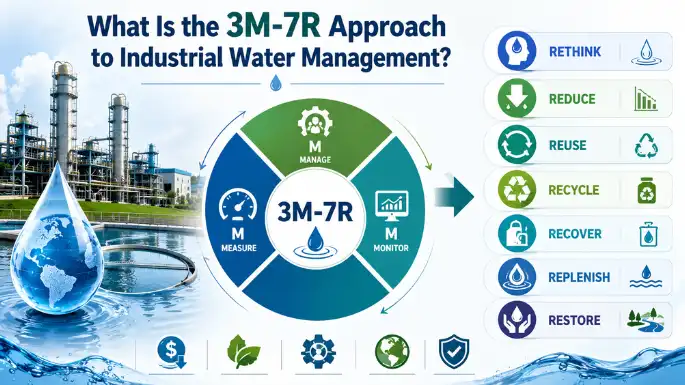
In the modern industrial landscape, water is no longer a low-cost utility, but a critical operational risk. Globally, freshwater demand is projected to outstrip supply by 40% by 2030, a crisis intensified by tightening environmental regulations and mandatory ESG reporting like India’s BRSR. Yet, traditional industrial water management remains reactive, under-measured, and fragmented leaving facilities exposed to hidden financial losses and compliance liabilities. To bridge this gap, the 3M-7R Framework provides a strategic blueprint to transform operations. Built upon Three Management Pillars (Monitor, Maintain, Manage) and Seven Action Priorities (Reduce, Replace, Reuse, Recycle, Recover, Regulate, Report), this framework offers a structured roadmap to optimize consumption, mitigate risks, and unlock significant bottom-line savings.
The Problem 3M-7R Solves
Most industrial water management is:
- Reactive (descaling done when visible, not predicted)
- Under-measured (only boundary meter, not point-of-use)
- Fragmented (maintenance, production, compliance, finance not coordinated)
- Under-scrutinised financially (bundled into general utilities)
- Poorly reported (no meaningful sustainability data)
THE 3M FRAMEWORK: Three Management Pillars
M1: Monitor
Quantity Monitoring:
- Sub-metering at all major use points
- Real-time flow measurement (ultrasonic/electromagnetic meters, BMS-integrated)
- Water balance modelling to identify unexplained losses
Quality Monitoring:
- Online continuous: conductivity, pH, temperature, turbidity
- Regular lab: hardness, TDS, LSI, heavy metals, TOC, microbiological content
- Process-specific: boiler water, cooling tower, RO performance, effluent
Performance Monitoring:
- Specific energy per m³ of water heated (boiler/heat exchanger scaling indicator)
- Cooling tower approach temperature logging
- Equipment maintenance frequency vs. water quality correlation
M2: Maintain
Water Treatment System Maintenance:
- Softener regeneration audit and optimisation
- RO membrane monitoring (normalised flux and salt rejection proactive not reactive)
- Dosing system calibration
- Filtration media performance tracking
Boiler & Steam System:
- Internal inspection with scale thickness measurement
- Blowdown valve testing
- Steam trap survey and repair
- Feed water heater/deaerator maintenance
Cooling Tower:
- Fill media inspection and cleaning/replacement schedule
- Nozzle inspection and cleaning
- Basin cleaning
- Drift eliminator inspection
- Fan/pump/gearbox maintenance coordinated with water quality data
M3: Manage
Water Balance Analysis: Tracks all inputs, outputs, transformations. Regular reporting (monthly minimum; real-time for large facilities).
Full Water Cost Accounting:
- Incoming water tariff
- Wastewater and effluent treatment/disposal
- Chemical treatment
- Energy attributable to water (pumping, heating, cooling)
- Equipment maintenance from water quality issues
- Regulatory compliance costs
Regulatory Compliance Management: Discharge consent, abstraction licensing, chemical registration, environmental permitting.
Sustainability & ESG Integration:
- Water intensity metrics (water per unit of production)
- CDP Water Security, GRI 303, UN SDG 6 reporting
- ISO 46001 (Water Efficiency Management Systems) certification
- BRSR (India: required for top 1,000 listed companies)
THE 7R PRINCIPLES: Seven Action Priorities

R1: Reduce (Highest Priority)
- Leak detection & repair (facilities routinely lose 10–30% to undetected leaks)
- Process water optimisation
- Cooling water CoC increase (CoC 3→5 reduces makeup consumption ~15%)
- Equipment upgrades
- Behavioural/procedural change
R2: Replace
- Rainwater harvesting
- Groundwater (where licensed)
- Treated surface water
- Reclaimed municipal wastewater
R3: Reuse
- Cooling tower blowdown reuse (for washdown, dust suppression, toilet flushing)
- Boiler condensate recovery (20–40% reduction in feed water demand; preheated, high-purity)
- Process rinse water cascading (80–90% water reduction vs. single-stage rinsing)
- Cooling water heat integration
R4: Recycle
- On-site wastewater treatment plant → reuse in cooling/boilers
- Zero Liquid Discharge (ZLD) – no liquid effluent released
- Closed-loop cooling systems
- RO concentrate treatment and recycling
R5: Recover
- Heat recovery from hot effluent
- Chemical recovery from high-concentration streams
- Water recovery from humid exhaust air
- Energy recovery from pressure drops (recovery turbines)
R6: Regulate
- Discharge consent management
- Abstraction licence compliance
- Chemical inventory & registration (REACH/BIS)
- Environmental permitting (integrated pollution prevention)
R7: Report
Internal (Monthly minimum):
- Total consumption vs. target
- Water intensity
- Key quality parameters
- Chemical treatment performance and costs
- Maintenance activities
- Non-compliance events and corrective actions
- Cost vs. budget
Corporate/ESG:
- CDP Water Security questionnaire
- GRI 303 (Water and Effluents)
- UN SDG 6 alignment
- BRSR (India mandatory for top 1,000 listed companies)
Implementation Roadmap
Phase | Timeline | Key Activities |
1: Baseline & Assessment | Months 1–3 | Water audit, sub-metering, water balance model, benchmarking |
2: Quick Wins | Months 3–6 | Fix leaks, optimise existing systems, establish monitoring, appoint Water Steward |
3: Capital Investment | Months 6–18 | Prioritise ROI-positive projects, water procurement criteria, risk register |
4: Advanced Optimisation | Months 18+ | ISO 46001 certification, ESG reporting integration, ZLD exploration, supply chain engagement |
Case Study: API Pharmaceutical Facility, Hyderabad
Metric | Before 3M-7R | After 18 Months |
Annual water consumption | 180,000 m³ | 138,000 m³ (−23%) |
Annual water cost | ₹1.8 crore | ₹1.28 crore (−29%) |
Boiler fuel waste | ₹35 lakh/year | Eliminated |
RO membrane replacement | Every 14 months | Every 26 months |
Cooling tower efficiency loss | 18% | 4% |
Compliance incidents | 3/year | 0 |
Net Annual Benefit | ~₹1.0 crore | |
Investment | ~₹1.6 crore | |
Payback Period | 19 months |
Conclusion
Implementing the 3M-7R Framework transitions industrial facilities from a reactive, high-risk approach to a proactive, resilient model that drives tangible financial value. As demonstrated by the Hyderabad pharmaceutical case study, executing this 18-month roadmap can slash water consumption by 23%, extend equipment lifespans, and eliminate waste, achieving full payback in under two years. In an era of escalating water scarcity, rising tariffs, and strict ESG compliance, continuing to treat water as an unmeasured utility poses severe operational and legal risks. By embedding the 3M-7R Framework, forward-thinking organizations can future-proof their operations against climate volatility, secure a distinct competitive advantage, and preserve a critical shared resource.
Frequently Asked Questions (FAQs)
What makes the 3M-7R Framework different from traditional industrial water management?
Traditional approaches are usually reactive, under-measured, and fragmented—treating water as a hidden utility cost. The 3M-7R Framework shifts operations into a proactive stance. It integrates continuous sub-metering (Monitor), targeted asset care (Maintain), and financial accountability (Manage), while prioritizing seven clear action steps to systematically eliminate waste and lower costs.
How does the framework help companies comply with ESG regulations like India's BRSR?
The R7 (Report) and M3 (Manage) pillars are purpose-built for modern sustainability reporting. By enforcing regular water balance models and calculating water intensity metrics (water used per unit of production), the framework provides the exact data required by GRI 303, CDP Water Security, and the Business Responsibility and Sustainability Report (BRSR) mandatory for India’s top listed companies.
We already track our main water meter. Why do we need "Sub-metering" (M1)?
A main boundary meter only tells you how much water you bought, not where it went. Sub-metering at major use points allows you to build a dynamic water balance model. Without it, underground leaks, cooling tower over-overflows, and inefficient machinery can waste 10–30% of your water completely undetected.
Recent Post
Get the Latest Updates on SOFTFLOW™
Stay informed about new tips, offers, and product updates.
