Affordable Industrial Water Softener Systems for Factories in India
Introduction
If you’re managing a factory in India, recent headlines aren’t just news; they’re your new operational reality. “Chennai’s Day Zero Scare,” “NITI Aayog’s Water Crisis Report,” and “State CPCBs Tightening Effluent Norms” all point to one truth: water is no longer just a utility line item; it’s a critical, costly, and regulated resource. For Indian manufacturers, investing in a water softener isn’t a luxury; it’s essential for protecting boilers, ensuring product quality, and reducing chemical costs.
But with tight margins, “affordable” doesn’t mean “cheapest.” It means maximum return on investment (ROI). As an expert who has analyzed dozens of installations, let’s cut through the clutter and identify what “affordable” truly means for an Indian factory focusing on lifecycle cost, local availability, and real-world performance.
Why “Affordability” in India Has a Different Formula
In the Indian context, an affordable system must account for:
- High & Fluctuating Hardness: Water profiles vary wildly from state to state, with Rajasthan and Gujarat often having extreme hardness.
- Unstable Power Supply: Systems must handle voltage fluctuations or incorporate failsafes.
- Skilled Maintenance Gaps: The ideal system is robust and easy for in-house staff to manage.
- The Real Cost of Water Waste: As municipal water tariffs rise and tanker costs skyrocket, systems that waste less water in regeneration are smarter long-term buys.
The Contenders: Affordable & Scalable Technologies for Indian Factories
Here’s a breakdown of the most cost-effective, proven systems suitable for Indian industrial scale.
1. Twin Alternating Ion Exchange Softeners: The Cost-Effective Workhorse
- How it Works: Two resin tanks operate in tandem. While one is actively softening, the other is on standby or regenerating. This ensures an uninterrupted 24/7 softened water supply, critical for continuous process industries like textiles or chemicals.
- Why it’s Affordable for India:
- No Downtime: Eliminates production stoppages for regeneration, protecting your output.
- Local Availability: Resin, valves, and tanks are widely available domestically, keeping capital and maintenance costs lower.
- Handles High Hardness: Proven technology for India’s challenging water.
- Best For: Mid to large-scale factories with continuous operations (e.g., textiles, food processing, chemical manufacturing) and a reliable salt supply chain.
2. Efficient Non-Electric Softeners: Simplicity for Smaller Operations
- How it Works: Uses a mechanical water meter to trigger regeneration based on actual gallon usage (Demand Initiated Regeneration – DIR), not a timer. Often uses a simple hydraulic valve instead of complex electronic controls.
- Why it’s Affordable for India:
- Lower CapEx & OpEx: No electronic control head, reduced complexity, and extremely low power consumption.
- Reduced Salt & Water Waste: Regenerates only when needed, saving 20-30% on salt and water compared to timer-based models—a major cost saver.
- Durability: Fewer electronic parts mean less vulnerability to voltage spikes.
- Best For: Small to mid-sized factories, packaging units, or as a decentralized unit for a specific boiler or cooling tower. Less ideal for extremely high, continuous flow rates.
3. Template Assisted Crystallization (TAC): The Low-OpEx Long-Term Player
- How it Works: A physical process that converts hardness minerals into harmless nanocrystals. No salt, no regeneration, and no wastewater.
- Why it’s Affordable for India:
- Zero Running Chemicals: Eliminates the recurring and fluctuating cost of industrial salt.
- Zero Water Waste: Does not waste a single litre for regeneration—a huge advantage where water is scarce or expensive.
- Low Maintenance: No brine tanks, pumps, or complex cycles.
- Consideration: Higher initial investment than basic softeners, but ROI is often under 2 years for facilities with high salt/water costs. Media needs replacement every 4-6 years.
- Best For: Factories with strong sustainability goals, in water-stressed regions, or those looking to eliminate salt handling and brine disposal headaches.
The Cost-Saving Framework: How to Choose for Your Factory
Follow this decision matrix to align technology with your budget and needs:
Your Primary Driver | Recommended Technology | Key Cost-Saving Reason |
Uninterrupted 24/7 Supply | Twin Alternating Ion Exchange | Prevents costly production downtime. |
Lowest Upfront Investment | Efficient Non-Electric (DIR) Softener | Lower capital cost, saves salt/water. |
Lowest Operating Cost | Template Assisted Crystallization (TAC) | No salt, no wastewater, minimal power. |
High Hardness (>500 ppm TDS) | Ion Exchange (Twin or DIR) | Proven, robust removal capability. |
Water Scarcity / High Tanker Costs | TAC or Efficient DIR | Minimizes or eliminates water waste. |
4 Actionable Steps to Get Your Affordable System
- Test, Don’t Guess: Get a comprehensive water analysis from a local lab. Knowing your exact hardness, TDS, and iron content is the first step to avoiding an undersized or over-engineered system.
- Calculate Total Lifecycle Cost: Ask vendors for a 5-year cost projection including: Capital Cost + Salt + Water for Regeneration + Maintenance + Waste Disposal Costs.
- Prioritize Service & Spares: The most “affordable” system becomes a liability if the controller breaks and the part is imported with a 6-week lead time. Choose suppliers with a strong pan-India service network and locally stocked spares.
- Explore Hybrid Models: For large plants, a centralized TAC system for boiler protection paired with a smaller ion-exchange unit for a specific process line can be the most cost-effective overall architecture.
Conclusion
Investing in an affordable industrial water softener is a strategic move for any Indian factory. By tackling hard water at the source, you slash energy costs, prevent expensive equipment breakdowns, and improve product quality.
In a market where every rupee counts, a reliable softening system isn’t just an expense – it’s an investment that typically pays for itself within the first year through reduced maintenance and increased efficiency.
Frequently Asked Questions (FAQs)
How do I know if my industrial softener is sized correctly?
You must match the “Continuous Flow Rate” of the softener to your plant’s peak demand. If your pressure drops significantly during high usage, or if hardness “leaks” through, the system is likely undersized.
Can salt-free systems really handle high hardness levels?
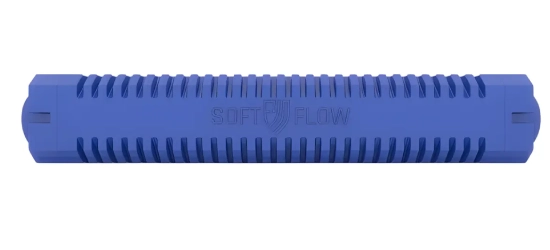
Yes. While they don’t remove the minerals, technologies like SOFTFLOW® are highly effective at preventing scale in boilers and heat exchangers even at hardness levels exceeding 500 ppm.
What is the maintenance schedule for a SOFTFLOW® system?
Unlike salt-based systems that need weekly salt loading, SOFTFLOW® systems are designed for minimal intervention, typically requiring only a periodic check of the media or electronic components.
Does softening water reduce TDS?
Traditional salt-based softeners actually slightly increase TDS because they swap one ion for another. Only RO systems or deionization effectively reduce total TDS.
Recent Post
Get the Latest Updates on SOFTFLOW™
Stay informed about new tips, offers, and product updates.