
Can Water Softener Extend the Lifespan of Hospital Equipment?
Introduction
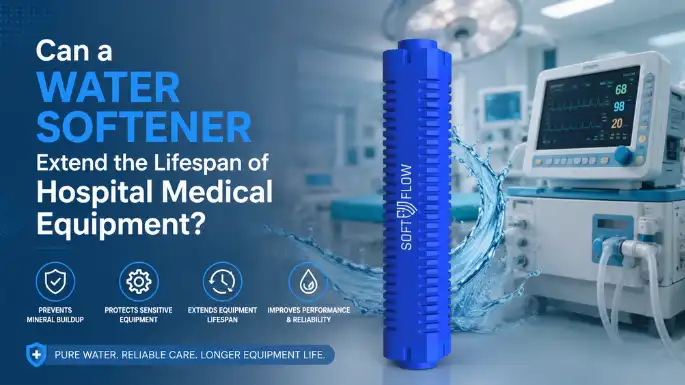
Yes, a commercial water softener directly extends the lifespan of hospital medical equipment by eliminating dissolved calcium and magnesium ions before they precipitate out as destructive limescale. In healthcare facilities, installing a dedicated water softener for hospital medical equipment protects high-value assets, such as autoclaves, hemodialysis pre-treatment systems, and laboratory analyzers from thermal insulation, sensor miscalibration, and micro-fluidic blockages. This proactive water conditioning defers expensive capital replacement cycles, minimizes clinical downtime, and ensures strict compliance with medical sterilization standards.
The Hidden Danger: How Hard Water Damages Medical Equipment

To understand why a commercial water softener is vital for healthcare infrastructure, one must analyze the chemical and mechanical destruction caused by unconditioned water. When hard water is subjected to heat or pressure shifts within clinical machinery, dissolved minerals crust into limescale.
Inside a high-precision medical environment, this scaling causes three primary types of failure:
1. Thermal Insulation and Overheating
Limescale serves as an incredibly effective thermal insulator. When mineral scale coats heating elements or internal heat exchangers, the machinery must draw excess electrical power to reach required operational temperatures. This continuous over-exertion triggers rapid thermal fatigue, electrical faults, and premature component burnout.
2. Restriction of Micro-Fluidic Pathways
Modern diagnostic and therapeutic devices feature intricate, narrow internal tubing designed to transport precise volumes of water, reagents, or steam. Even a microscopic layer of mineral buildup constricts these lines, altering internal fluid dynamics, increasing system pressure, straining internal pumps, and causing systemic mechanical breakdowns.
3. Degradation of Sensitive Calibration Sensors
Precision is non-negotiable in modern healthcare. Advanced medical devices utilize sensitive probes to monitor flow rates, chemical concentrations, and temperature variations. When mineral deposits encrust these sensors, they lose calibration accuracy, directly risking patient safety in critical environments like dialysis units.
Critical Infrastructure Protected by Commercial Water Softeners
Implementing an industrial-grade water conditioning system acts as an operational shield across multiple high-value hospital departments:

- Autoclaves and Sterile Processing Departments (SPD): Autoclaves rely on high-temperature steam to eliminate pathogens from surgical instruments. Hard water creates scale on boiler coils, leading to frequent element failures. Furthermore, mineral carryover leaves “white spots” on surgical trays, which can entrap bio-burden and cause sterilization cycles to fail validation protocols.
- Hemodialysis Units: While Reverse Osmosis (RO) systems are the medical standard for dialysis water purity, RO membranes are highly vulnerable to mineral fouling. A heavy-duty water softener serves as an indispensable pre-treatment stage, stripping out hard minerals before they reach the RO system to ensure a continuous stream of safe, compliant water.
- Laboratory Analyzers: Automated laboratory analyzers process blood, tissue, and fluid samples around the clock. If stray calcium or magnesium ions contaminate the testing environment, they interfere with precise chemical reactions, alter photometric readings, and trigger false diagnostic data.
- Commercial Boilers and HVAC Systems: Beyond direct patient-care devices, a hospital relies on massive boiler plants and cooling towers. Hard water running through these systems results in skyrocketing energy bills, localized pipe corrosion, and unexpected plumbing leaks that can disrupt hospital workflows.
Technical Comparison: Hard Water vs. Softened Water in Healthcare
Operational Vector | Unconditioned Hard Water Impact | Softened Water (Commercial System) Impact |
Asset Longevity | High risk of premature component failure due to scale accumulation. | Maximum engineered equipment lifespan achieved. |
Energy Efficiency | Scale requires up to 20-25% more energy to heat water. | Optimal heat transfer and lower utility consumption. |
Maintenance Profile | Frequent emergency repair calls and costly acid-descaling downtime. | Scheduled, predictable preventative maintenance cycles. |
Chemical Efficacy | Minerals bind to and neutralize detergents and disinfectants. | Maximized lathering and true chemical sterilization efficacy. |
Selecting a Healthcare-Grade Water Softening System
Because a medical facility operates continuously, residential or light commercial water treatment systems are insufficient. A robust healthcare water strategy requires specific engineering parameters:
- Twin-Alternating Configurations: Multi-tank designs ensure that while one tank is undergoing its necessary mineral regeneration cycle, a secondary tank immediately handles the flow, providing an uninterrupted, 24/7/365 stream of soft water.
- Volumetric Control Microprocessors: Advanced control valves monitor water consumption in real-time, optimizing salt and water usage during regeneration cycles based on actual volume rather than arbitrary timers.
- Regulatory Compliance: The entire installation must align with regional building codes, local health department standards, and medical device processing water regulations (such as AAMI ST108 standards).
Conclusion:
To extend the lifespan of hospital medical equipment, integrating a commercial water softener is a foundational requirement. Hard water causes internal scale buildup, insulates heating elements, blocks micro-fluidic lines, and miscalibrates critical diagnostic sensors. Utilizing a dedicated water softener for hospital medical equipment safeguards high-value assets like autoclaves and dialysis RO pre-treatment units, reducing unexpected downtime, cutting utility costs by keeping heating surfaces clean, and maintaining absolute sterile processing efficacy.
Don’t wait for a critical mechanical failure to reveal an underlying water quality issue. Contact our commercial water treatment specialists today to schedule a comprehensive water quality audit for your healthcare facility.
Frequently Asked Questions (FAQs)
Does a water softener remove bacteria from hospital water?
No. A water softener only removes minerals like calcium and magnesium. To kill bacteria and pathogens, the hospital must use UV sterilization, chlorination, or ultrafiltration.
Is softened water alone enough for dialysis machines?
No. Softened water is only a “pre-treatment” step. Dialysis requires much higher purity, which is achieved by passing the softened water through Reverse Osmosis (RO) and deionization systems.
How does hard water cause "white spots" on surgical tools?
During sterilization, hard water minerals carry over into the steam. When the steam evaporates, it leaves behind calcium deposits (white spots) that can harbor bacteria and damage delicate instruments.
Can a water softener reduce a hospital's energy bills?
Yes. Even 1.5mm of scale buildup can increase energy consumption by 15% to 25%. By keeping heating elements clean, a commercial water softener ensures the system runs at peak efficiency.
Can SOFTFLOW® handle the water volume of a large hospital?
Yes. SOFTFLOW® offers scalable commercial water softener configurations that can process thousands of liters per hour, supporting everything from sterile processing departments to large-scale boiler plants simultaneously.
Recent Post
Get the Latest Updates on SOFTFLOW™
Stay informed about new tips, offers, and product updates.
